
We begin this analysis by shedding some light on Wakana Gojo because without keeping him in mind, you cannot completely understand What is Marin Kitagawa Personality. Surprisingly, we have only analyzed the first three episodes till now of My Dress-Up Darling, and the cracks in this anime are becoming more visible. Simply, the series starts revealing a much more complicated dynamic beneath its emotional and romantic presentation.
What Is Marin Kitagawa Personality? Why Understanding Wakana Gojo Comes First
At surface level, the anime tries to present to the audience:
- acceptance
- understanding
- confidence
- emotional healing
- cosplay passion
- “being yourself”
However, once you dive a bit deep into the story, you will notice the emotional framing of My Dress-Up Darling is starting to slip. So, we begin our analysis by first removing the biased glasses. After that, we examine carefully the actual events shown in this anime, and several deeper issues begin appearing:
- unrealistic relationship progression
- emotional dependency
- isolation reinforcement
- boundary removal
- idealized validation
- manipulation-like dynamics hidden behind “supportiveness”
- normalization of dangerous behavior
Also, the most important point is this:
The series constantly portrays these things as wholesome and emotionally beautiful instead of questioning them seriously.
But before examining Marin’s psychological influence on Gojo, it is important to understand how their relationship begins in the first place. Our analysis of [My Dress-Up Darling’s first three episodes] takes a closer look at their unusual first meeting, Marin’s sudden comfort around Gojo, and the surprisingly rapid development of their relationship.
Gojo’s Isolation — Society’s Fault or a Deeper Psychological Problem?
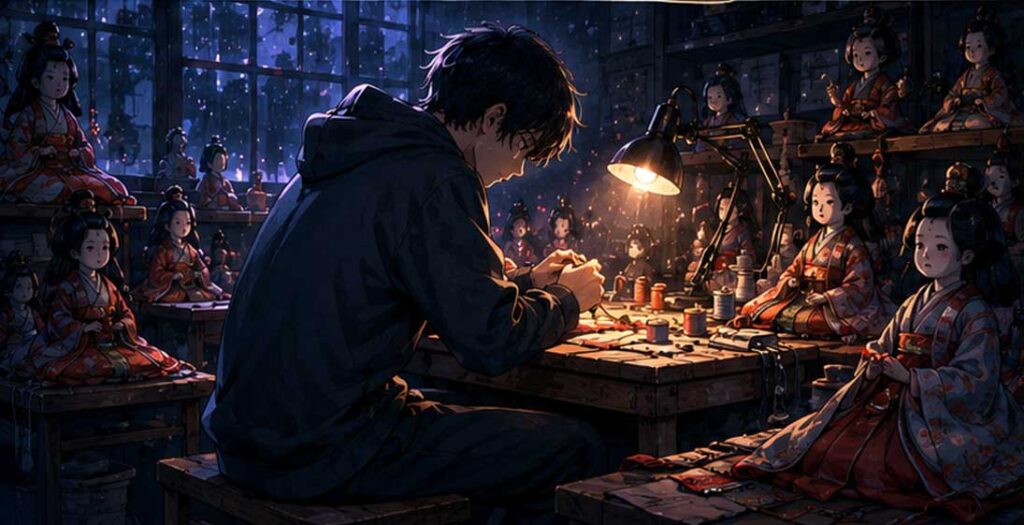
Symbolic illustration representing Gojo's isolation, emotional withdrawal, and psychological escape.The anime, from the very start, episode 1 of season 1, tries to frame Wakana Gojo as a misunderstood victim.
As a child, he admired Hina dolls and was rejected by a little girl who said boys should not play with dolls. First of all, both of them were small, innocent kids, but this anime forces this emotional message on the audience:
“Society unfairly judges harmless interests.”
Does Wakana Gojo have Social Anxiety
Indeed, the problem is that the anime pushes of the childish rejection idea in an extremely one-sided way.
Because even before serious or, in our opinion childish rejection happens:
- Gojo already shows intense emotional attachment to Hina dolls.
- The boy heavily isolates himself.
- Gojo struggles with normal interaction.
- He emotionally retreats into dolls as comfort.
What’s more, the anime My Dress-Up Darling rarely questions whether:
- His obsession itself may also contribute to his isolation.
- Gojo’s unhealthy social withdrawal may need correction.
- Emotional balance is missing.
Instead, the story mostly shifts blame outward toward “society.”
Gojo Wakana: Passion, Identity, and Psychological Escape
More importantly, it is necessary to shed light on a major and critical issue, which is that Gojo’s attachment to Hina dolls was not presented in the anime merely as a hobby, but rather the anime repeatedly presents the dolls as:
• Emotional comfort
• Identity attachment
• Psychological escape
• Social retreat
• Emotional safety
Gojo does not merely “like” Hina dolls.
Instead:
• He emotionally retreats into them
• Struggles connecting with normal social environments
• Spends most of his emotional energy around them
• Ties his self-worth heavily to this isolated world
Alarmingly, this is something which creates an important psychological concern:
The Gojos’ obsession with Hina Dolls itself may partially contribute to Gojo’s inability to socially function normally.
However, the anime not only tries to distance itself from psychological problem but also almost never seriously explores this possibility.
Instead, it mostly frames:
• Society as the problem
while
• Gojo’s internal imbalance remains largely protected from criticism.
This distinction matters because:
Healthy passion and unhealthy emotional escape are not always the same thing.
Even Gojo’s grandfather indirectly hints at balance by telling him:
- Friendship matters
- Youth experiences matter
- Social growth matters
Surprisingly, the anime changes its road and quickly moves away from this realistic direction. Ignoring all, they instead introduce Marin as someone who instantly validates Gojo without first challenging his deeper problems.
The Grandfather Represents the Series’ Briefest Moment of Realism
Something we should not avoid, the scene where Gojo’s Grandfather try to teach him that the way he is choosing for himself will never end up any success, satisfaction, or happiness. By examining carefully, Grandfather’s tone was polite, but the message for Wakana Gojo was a serious warning.
Clearly, the grandfather was telling him about the complete isolation that approaches Gojo very fast. Notably, only at the beginning of this anime you are exposing to such important details, if you are a careful viewer that not consume any content but that poses quality.
Indeed, this is extremely important because the grandfather does not attack Gojo’s interests themselves.
It was Seem this Anime is now reflecting on Real Important Stuff
For a brief moment, this is the part of this anime which almost appears ready to explore:
• Balance
• Emotional maturity
• Social development
• Healthier integration into normal life
But shortly afterward, the series rapidly shifts away from this direction. Sadly, the anime does not challenge Gojo’s isolation. Rather, the Marin Kitawaga enters the story as someone who almost perfectly adapts to it.
This creates the feeling that:
Emotional accommodation replaces meaningful development.
The Anime Romanticizes Escapism
Certainly, one of the biggest patterns in Episodes 1–3 is that emotional escapism keeps getting rewarded.
Gojo:
- Talks to dolls
- Spends most of his life isolated
- Lacks social confidence
- Struggles heavily with normal interaction
- Becomes emotionally dependent very quickly
Yet instead of pushing him toward:
- Emotional maturity
- Balanced confidence
- Healthier social growth
- Realistic interaction skills
From here, the anime take audiences on the worse ride, the anime introduces a fantasy figure who adapts entirely around his condition.
This creates a dangerous emotional fantasy:
“You do not need serious self-development if someone appears who fully validates your isolation.”
Without a doubt, that idea sounds emotionally comforting. Especially, anyone who is suffering from isolation. We have to keep in mind that reality usually does not work that way.
Fantasy Comfort vs Genuine Human Growth
Certainly, you would notice one of the deepest hidden themes across the first three episodes is the difference between emotional comfort and actual personal growth. More surprisingly, the anime takes it a few steps further by repeatedly creating situations where:
• Gojo is emotionally validated
• Lonely boy isolation is accepted
• Wakana’s awkwardness is accommodated
• His emotional dependence gets rewarded
Opposite to that, we all know, genuine growth usually requires:
• Discomfort
• Self-reflection
• Challenge
• Gradual improvement
• Healthier adaptation to reality
Dangerously, the My Dress Up Darling anime often creates the opposite structure like the world bends around Gojo’s condition rather than forcing him to meaningfully overcome it.
This is one reason the relationship feels emotionally comforting to many viewers.
Because the fantasy being presented is not simply romance.
The fantasy is
“Someone will arrive who fully understands and adapts around your weaknesses without requiring difficult self-development first.”
Emotionally, that fantasy is extremely appealing.
But psychologically, it can also become unhealthy if viewers begin confusing accommodation with healing.
Marin’s “Supportive” Personality — Or Emotional Exploitation Hidden Behind Validation?
Hold on to your seats, this is where the anime becomes far more psychologically complicated. Clear as daylight, the series constantly presents Marin Kitagawa as:
- Caring
- Cheerful
- Understanding
- Emotionally intelligent
- Supportive
- Accepting
And yes, she often behaves warmly. Also, this is too good to be true. Marin was portrayed as a loyal, confident friend, a bold, beautiful girl, and she does not fear sharing her mind and ideas in public. Certainly, the anime tries to convince the audience that no matter how badly you are performing in life and need growth in various aspects, throw all these worries in the trash if a Marin-type personality is your girlfriend. The series forces this idea that Marin is more than enough; if she is by your side, you don’t need anyone. Additionally, she is a friend you can always rely on. Moreover, Marin Kitagawa is someone you can blindly trust and easily expose all your weaknesses and secrets to. Furthermore, Kitagawa will never use your weaknesses against you. Other than that, she takes great care of your emotional needs. So, forget about your problems and growth, just lean on Marin’s shoulder and begin crying.
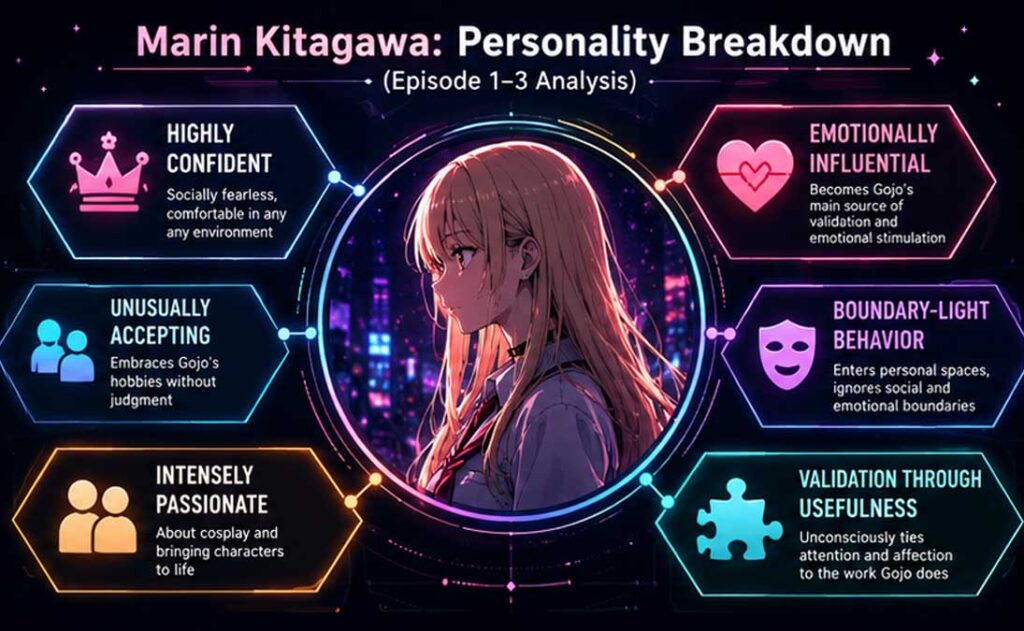
Major Contradiction Starts Appearing Almost Immediately
However, the story seems to be screaming something else to its audience, maybe from episode 1:
Marin tells Gojo:
- People are using him.
- Gojo needs boundaries.
- He should stand up for himself.
Indeed, the anime portrays this as proof of Marin Kitagawa’s emotional maturity. But then what happens afterward?
Marin herself gradually starts heavily using Gojo’s:
- Emotional loneliness
- Approval-seeking nature
- Social awkwardness
- Isolation
- Desperate need for validation
For her own cosplay goals. Yet, the series still remains busy in showing Marin Kitagawa as the positive person in Gojo’s life. Therefore, My Dress Up Darling almost never seriously questions this. Instead, it wraps the entire dynamic in:
- emotional music
- “cute chemistry”
- romantic framing
- wholesome presentation
So, they cleverly convince the audience to emotionally accept it without noticing the imbalance.
Validation as a Control Mechanism
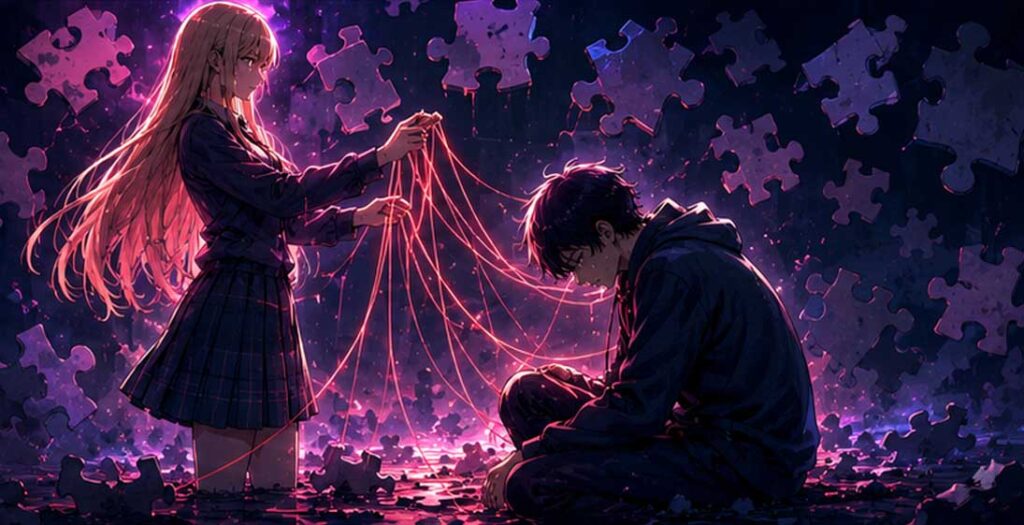
Symbolic artwork illustrating emotional attachment, dependency, and psychological influence.Clearly, Marin Kitagawa was presented like as a bright light in Gojo’s dark, alone, and silent life. However, if you watch closely, you will notice it easily without any effort that Gojo is an extremely vulnerable personality, and Marin is manipulating his vulnerabilities for her own aims. Before anyone gets angry, as we label Marin Kitagawa as a manipulator right now, please look and consider this:
Gojo is Vulnerable, and here are some prominent reasons:
- Has no real friends
- Lacks female interaction experience
- Is emotionally isolated
- Desperately craves acceptance
- Becomes attached very easily
People like Wakana Gojo are extremely vulnerable in real life.
In particular, individuals those posses such weaknesses become easy targets, because once someone:
- praises them
- validates their interests
- makes them feel “special”
- gives them emotional attention
As a consequence, they can quickly become emotionally dependent. This is worth noting; these vulnerabilities are part of Gojo’s personality. In reality, when a clever predator finds such weak individuals, they make these people more isolated very cleverly by telling them you don’t need any improvement, the society is to blame, as they misunderstood you. Furthermore, once they turn Wakana Gojo into people completely emotionally dependent on them, they make the second move and start draining their prey’s energies for their own benefit. As time passes, they begin using them as slaves. A critical point, Marin repeatedly fills exactly that role.
To elaborate, Marin Kitagawa:
- Praises his sewing
- Validates his obsession
- Emotionally comforts him
- Makes him feel uniquely understood
This becomes evident when Kitagawa slowly:
- Gets him to create costumes
- Consumes his time
- Pushes intense labor onto him
- Affects his sleep
- Affects his studies
- Emotionally hooks him deeper
Despite the Clear Control Mechanism, the anime presents this as:
- Wholesome teamwork
- Romantic bonding
- Emotional healing
Instead of asking whether:
Gojo is becoming psychologically dependent on usefulness and service.
Emotional Value Through Usefulness and Service
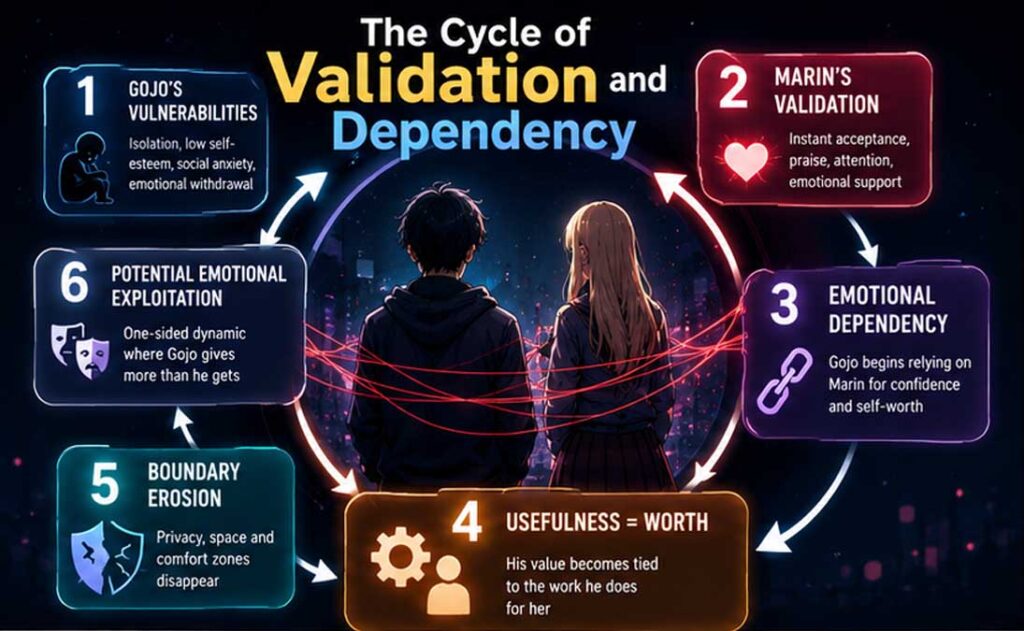
Another extremely important layer is how Gojo’s emotional worth gradually becomes tied to usefulness. Pay attention to, at first, Marin’s praise appears emotionally supportive.
Notice that Marin Kitagawa starts with:
• Compliments his sewing
• Admires his craftsmanship
• Validates his skills
• Makes him feel needed
But slowly, another structure forms underneath this dynamic:
Upon closer examination, we notice that Marin Kitagawa seems like she is gradually turning Gojo increasingly feels emotionally valuable only when he is useful to Marin.
Watch Wakana Gojo carefully:
• Acceptance
• Emotional closeness
• Connection
• Validation
All become linked to:
• Labor
• Service
• Costume production
• Constant effort for Marin’s goals
Story Getting Dark as Severe, Dangerous Psychological Pattern is Forming
Looking Deeper, the anime reveals that there is the creation of a psychologically dangerous pattern is underway where:
emotional worth becomes tied to productivity and usefulness for another person.
Notably, the anime My Dress Up Darling presents this as:
• cute teamwork
• romantic bonding
• emotional healing
Without a doubt, no one in their right mind would accept or buy this idea as portrayed in the anime. Unless someone turns their brain off and consumes content with eyes open only. Moreover, realistically, relationships are built heavily around:
• Over-sacrifice
• Exhaustion
• Usefulness-based validation
can become emotionally unhealthy very quickly.
Real-Life Manipulation Patterns Hidden Beneath the Fantasy
Significantly, this is the section of this analysis that helps a lot in understanding What is Marin Kitagawa Personality. Remarkably, from this part, just carefully compare Marin Kitagawa’s way to work her way to real-life manipulative hunters. This is why the series becomes more concerning psychologically from here.
Let’s begin, if you notice accidently, real-life manipulative people often operate similarly around vulnerable personalities.
Especially socially isolated:
- boys
- girls
- teenagers
- lonely people
- anxious individuals
Fantasy Perfect Girlfriend or Twisted Hunter: Who is Marin Kitagawa
As an example, take Wakana Gojo as a real human. The manipulating twisted person starts their lethal process by emotionally. These twisted individuals who love to play with emotions often pretend and look emotionally “kind” at first:
- “I understand you.”
- “Others judge you unfairly.”
- “You can be yourself around me.”
- “Only I truly support you.”
And slowly:
- dependency forms
- attachment deepens
- boundaries weaken
- emotional reliance increases
Surprisingly, does it not look similar to Wakana Gojo and Marin Kitagawa’s chemistry? Keep in mind, the manipulation does not always look aggressive.
Sometimes it appears as:
- support
- validation
- acceptance
- affection
- emotional safety
Consequently, all this makes it far more dangerous. Nevertheless, it seems the anime tries to heavily romanticize this exact emotional structure.
Final Thoughts
Above all, our analysis journey after only the first three episodes strongly indicating, about the question What is Marin Kitagawa Personality in the eyes appear far less wholesome than the anime wants viewers to believe.
Rather than Marin Kitagawa simply supporting Gojo, she repeatedly enters the life of an emotionally vulnerable and isolated boy, rapidly becomes his primary source of validation, and gradually ties emotional connection to usefulness and service.
Whether this behavior is intentional or not is still too early to determine.
However, one thing is already clear:
The anime consistently rewards dependency, accelerates intimacy, and removes boundaries. Not only that, My Dress Up Darling presents these patterns as emotional healing instead of seriously questioning them.
As a result, Marin Kitagawa feels less like a normal teenage girl and more like a fantasy figure designed to validate, comfort, and emotionally capture vulnerable viewers through Gojo.
And after only three episodes, that possibility is becoming increasingly difficult to ignore. This is only Part 1 of our Marin Kitagawa personality analysis. Future AnimeDecode articles will examine later episodes, her relationship with Gojo, and whether the concerns raised here become stronger or collapse entirely as the story progresses.